In Montessori schools, lessons often take place on the floor. This allows children to stay in motion. Sitting around a center and in a circle also promotes communication, which is why many discussions take place in this setting.
Students are divided into mixed-age learning groups, and each learning group has its own room. In addition, students can freely choose a learning activity during certain times. This corresponds to Montessori pedagogy, which builds on the individuality of each learner.
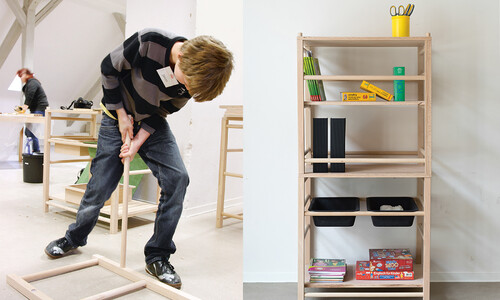
During my observation at the Montessori Community School Berlin-Buch, I noticed that writing and other activities on the floor did not work very well. The students were constantly busy trying to find a comfortable position to work in, often using available stools and chairs as working surfaces. This inspired me to develop a tool that makes it possible to work while sitting on the floor in an ergonomically favorable posture: a stool that is already designed to function as a table as well.
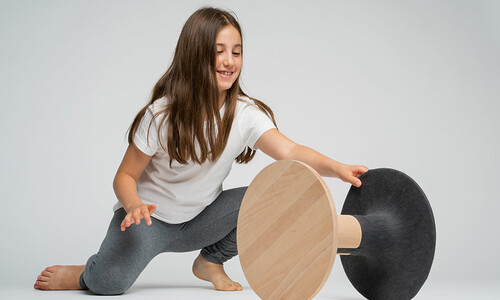
The design of this hybrid object is derived from its dual function, yet it looks like a normal stool. When looking more closely, one can recognize that it is made of two different materials and surfaces, each representing one of the two functions: a soft, rounded side made of fleece for sitting, and a smooth, flat wooden side for writing.
The tool — the stool — has a circular and symmetrical footprint, so that children can roll it on the floor and move it around the classroom. The soft, rounded side allows the angle of the working surface to be changed and adjusted to the right position. The children can hold the table with their legs, and if they do not want to sit on the floor, they can simply turn the stool over and sit on the soft side.
The stool is stable, easy to use, and supports the idea of a dynamic learning environment in the Montessori context.